

Season 3 of The Business Agents of Change is underway. The goal is simple: build AI systems you can hand off to clients, teammates, or your own audience, and get paid for them.
🎥 Get a sneak peek of what happened on day one, watch the clip here.
👉 Want to join? Second session is Thursday! Sign up and we'll help you catch up: The Business Agents of Change
A few themes from day one stood out.
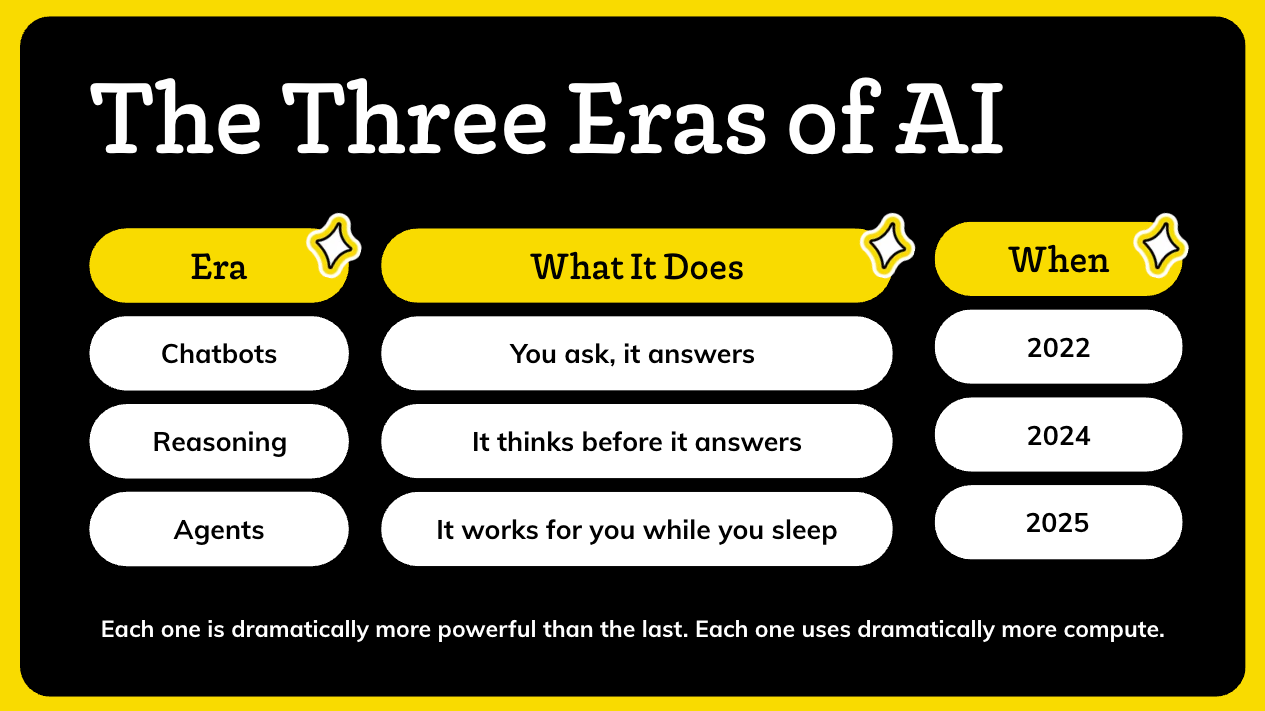
The Three Eras of AI
Most people are still using AI like a search engine. Ask a question, get an answer.
That was the first era of AI — the chatbot era — and it's great for things like customer support, where someone just wants a quick answer based on their history.
But it's only the beginning. The data backs this up: while most people use AI a few times a week for basic tasks, the companies actually investing in it are seeing real returns. Roughly three-fourths of enterprises spending on AI report positive ROI. The gap isn't access to the technology. It's implementation.
The second era arrived in late 2024 with reasoning models. Instead of predicting one answer word by word, these models generate multiple answers, review them, and pick the best one before you ever see it. That shift dramatically reduced hallucinations and let AI consider the whole picture instead of just the next word. It's the difference between a first draft and an edited one.
Now we're entering the third era: agents. With a chatbot, you ask and it answers. With a reasoning model, you tell it what to do and it checks its own work. With an agent, you tell it the goal — and it figures out how to get there. Instead of asking for a LinkedIn post that looks a certain way, you say "we need a marketing strategy," and the agent builds the pieces and brings them back. It acts without waiting for you to trigger every step.
That's a big deal for small teams.
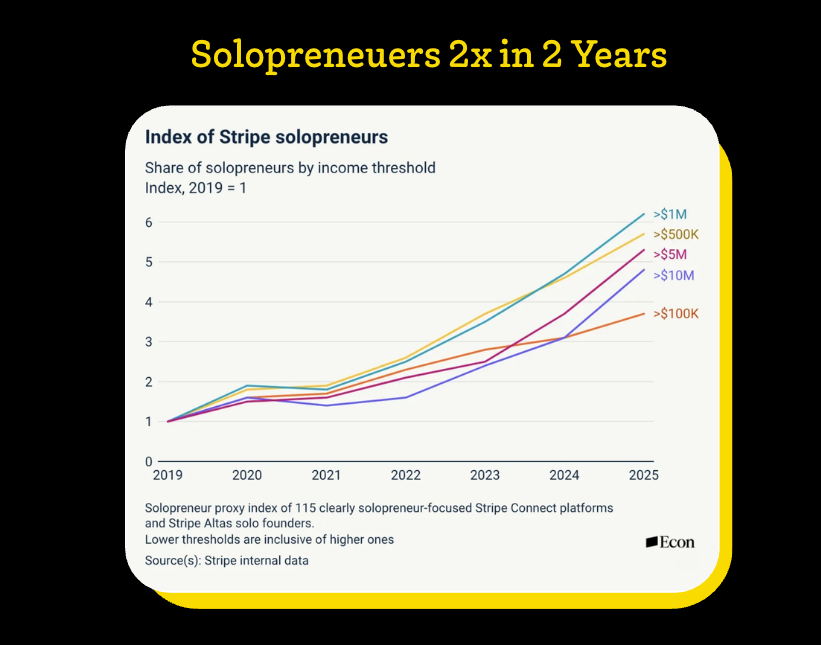
Stripe recently reported that the number of solopreneurs earning over $1 million a year has doubled since ChatGPT launched. Small teams can now perform at the scale of much bigger ones — not because they hired more people, but because they gave AI the goal and got out of the way.
Understanding AI changes how you build with it
Before touching any tools, the group got a plain language walkthrough of how AI actually works. Tokens, temperature, reasoning versus chat models, and why a tighter prompt gets you a better, cheaper answer. Once you understand what's happening under the hood, you stop guessing and start building on purpose.
A simple framework for better prompts
The RIPEN framework was the biggest unlock of the day. Role, Instruction, Parameters, Example, Notes. Five pieces that turn a vague ask into a prompt that consistently gets you what you want.
Tell the AI who to be. Give it the goal. Set the guardrails. Show it an example. Add any extra context. Builders in the cohort used this to write their first working prompts in minutes, live in the session.
One AI System
The other big theme was structure. Instead of a dozen disconnected chatbots, the cohort learned how to set up a "chief of staff" agent that sits on top of specialized agents for marketing, finance, support, or whatever the business needs. The client or teammate only ever talks to one place. Everything else happens behind the scenes.
That's the difference between a fun AI experiment and something you can sell or run a business on.
Why AI costs what it costs
Scott made a point of demystifying this: AI isn't free, even when it feels that way on a $20 a month ChatGPT plan. The group walked through the actual stack, compute, the model itself, the API that connects to it, the app you're chatting in, and the channel you're using it on. Seeing the whole chain makes it easier to understand where pricing is headed, and how to price your own AI systems instead of guessing.
Privacy got the same plain language treatment. What gets used for training, what zero data retention actually means, and why some client work needs that extra layer of protection.
What a finished system looks like
Scott showed real examples already live on Chipp: a full team of AI specialists built for an orthodontics practice, and a branded chat widget running on a med spa's website that alerts the team the moment someone asks about booking. Same brain, different front door, whether that's a website bubble, a text number, or a Slack channel your clients already live in.
Seeing the finished product made it click for a lot of builders in the room.
What you leave the cohort with
Over the next three weeks, we are going to cover addition topics like:
- Building a private, branded AI system live on Chipp, built for a real client or vertical
- Hands on reps with the Alchemist, building to your own spec instead of starting from zero
- Creating a pricing and packaging plan for selling your system, not just giving it away
- Developing a case study you can actually show off
Up next in the cohort: building a Daily Ping, a personal AI that checks your email and calendar every morning and tells you what actually needs your attention.
Still time to jump in
If this sounds like where your business needs to go, you can still join the cohort and catch up fast with the recordings. Head over to The Business Agents of Change to grab your spot.
See you in the next session!

