

Here are the highlights from the week that was in AI — and our spicy takes on what they actually mean. 🌶️
This week in AI:
- A Brown professor's chart caught (almost) his entire class cheating with AI — and 16 million people watched
- New data reveals what workers actually fear about AI, and it isn't losing their jobs
- The AI money is quietly shifting from the cloud giants to the chipmakers
- ESPN rolled out an AI that reads poker players' faces live on air
- And the case for going independent has never looked stronger
There's a clear through-line this week: AI isn't erasing work — it's redistributing leverage, toward the small, the independent, and the people willing to rebuild how they work.
On the Chipp side:
- 🎙️ Chipp Chatter is now a live show. Catch it and never walk into a meeting (or a dinner party) unprepared: Get notified on YouTube →
- 🎪 Chipp Con: Fargo — July 30. Afternoon workshop + evening Night Bazaar. Details →
AI Highlights from Around the Web
All But 3 Cheated: A Brown Professor's Chart Went Nuclear
Paul Graham surfaced the AI story of the week and 16.3M people watched it. A Brown professor (Serrano, ECON 1170) gave a take-home midterm, suspected widespread AI cheating, and made the final in-person. Then he plotted both. The orange dots (take-home midterm) cluster in the 90s and 100s. The gray dots (in-person final) collapse into the 30s, 40s, and 50s. His verdict: "Looks like all but 3 cheated on the midterm." Oh, and once the final went in-person, 18 students dropped the class and 9 didn't show.
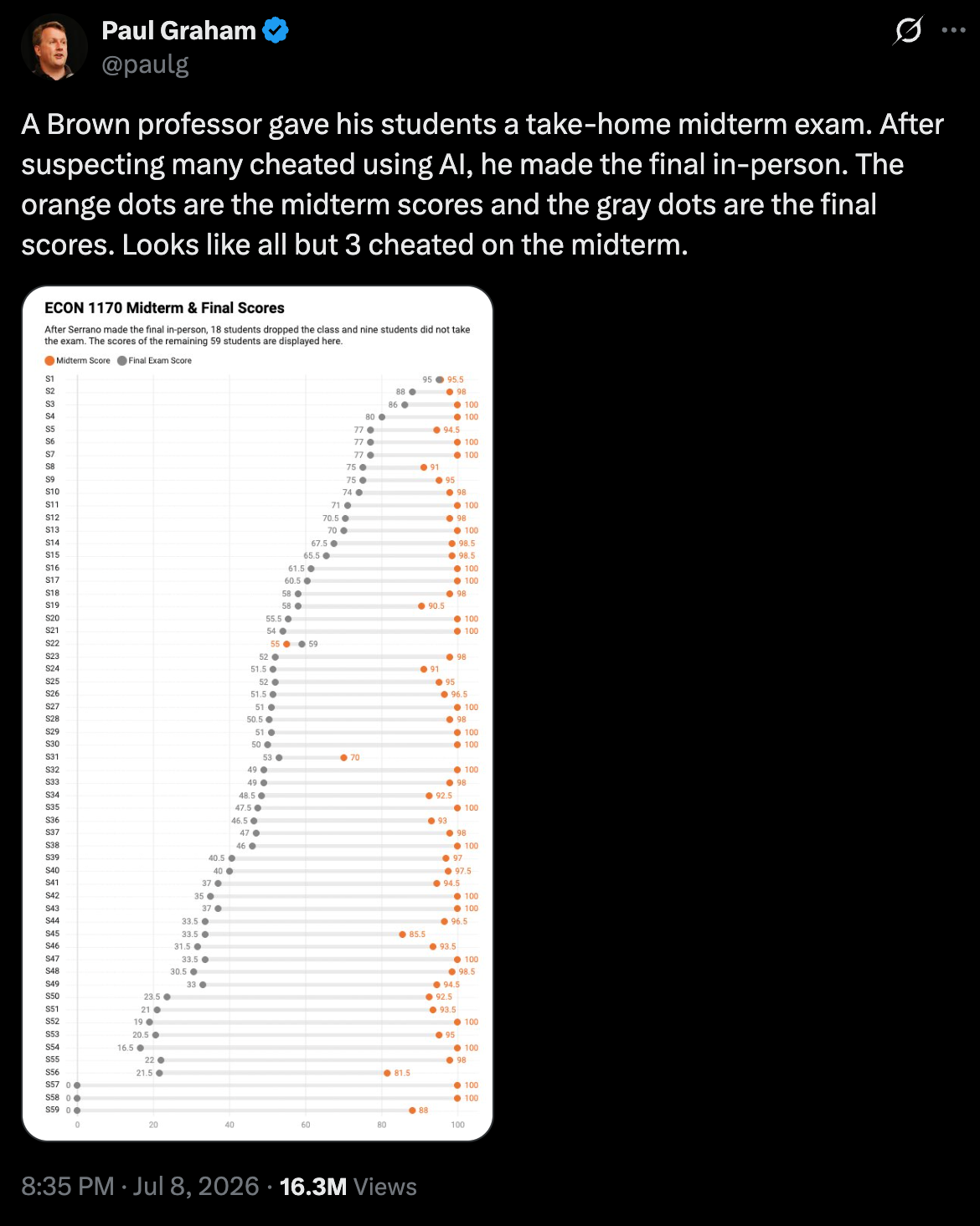
🌶️ The take-home exam didn't get cheated — it got exposed. It was never measuring what everyone pretended it measured. Businesses are having this exact reckoning right now: if the work can be done with AI at home, then "can you do it without AI" is the wrong test. The move isn't to ban the tool and drag everyone back into the room — it's to assume AI and raise the bar for what "good" even means. The professor found his cheaters. The harder question is what a take-home should ask at all in 2026.
What Workers Are Actually Afraid Of (It's Not Layoffs)
Lenny Rachitsky dropped a large-scale survey on AI and work, and the headline finding flips the usual narrative. "Losing my job to AI" came in near the bottom of workers' fears, at just 22%. What actually keeps people up: being asked to do more for the same pay (51%), an unsustainable pace (46%), and watching the quality of their work slip (41%). In his words: "Every gain becomes the new baseline, and the people expected to hit it are running out of room to breathe."
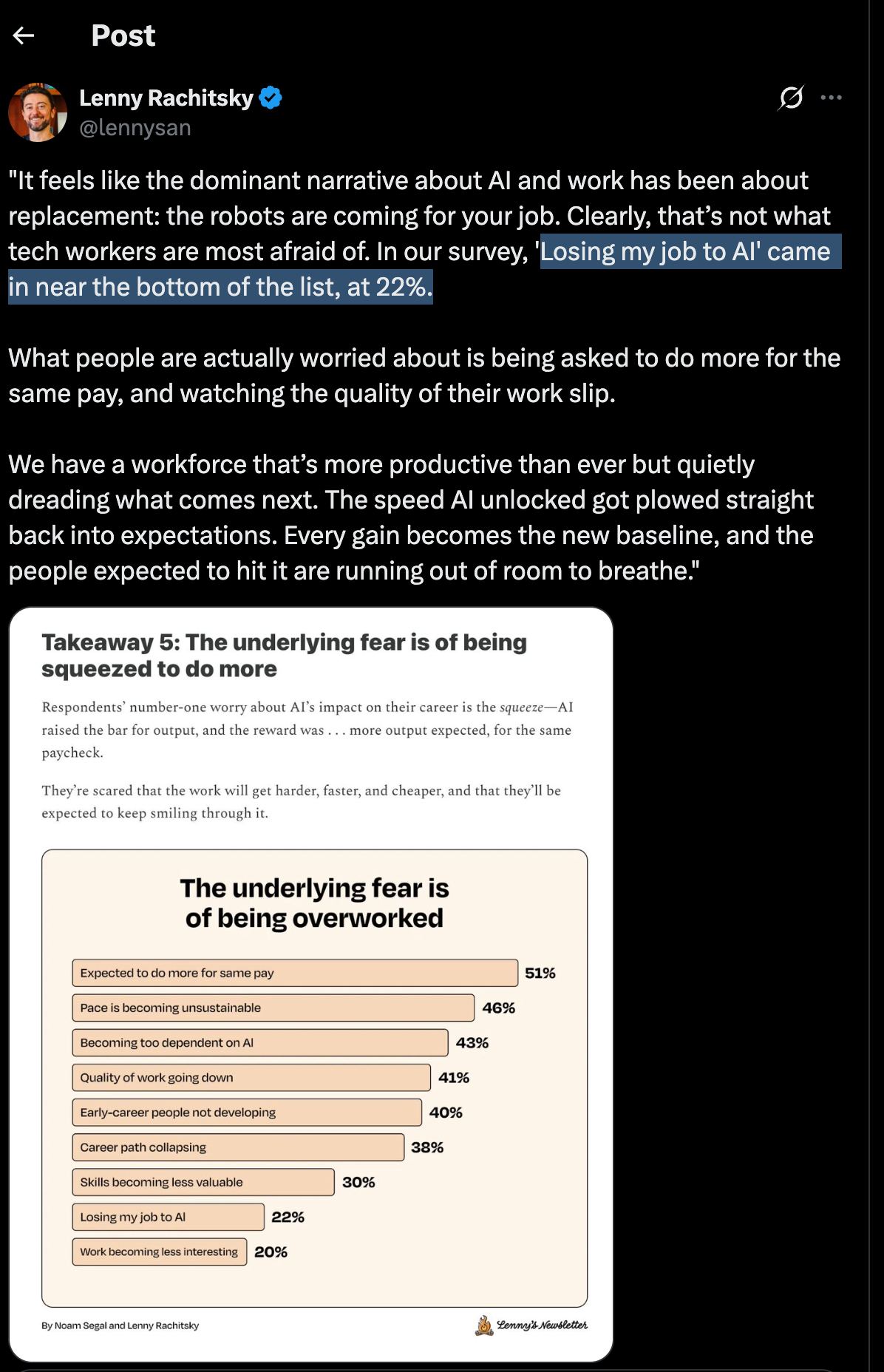
🌶️ This is the most honest chart about AI and work we've seen all year. Nobody's lying awake over "the robots are coming" — they're exhausted because every productivity gain instantly became the new floor. Here's the Chipp read: the squeeze is real, but it only crushes you when AI stays a personal side-hustle instead of a system. When agents own the coordination layer — the scheduling, the follow-ups, the tier-1 support — the extra output doesn't come out of your evenings. Build the system, or become the system.
Meanwhile: Founders Are the Happiest People in Tech
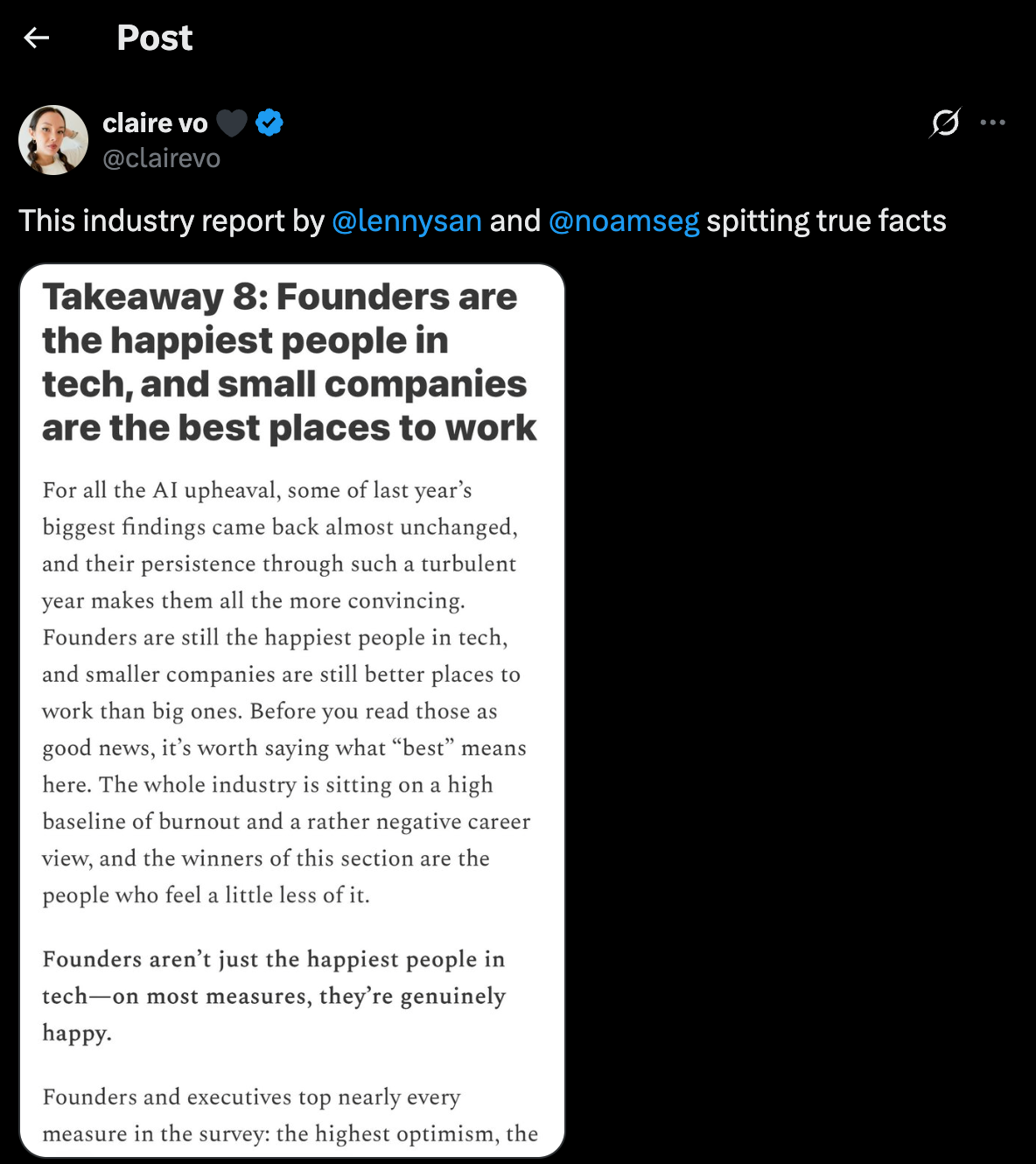
From the same report, a finding Claire Vo flagged as "spitting true facts": through the most turbulent year tech has ever had, the biggest results came back almost unchanged. Founders are still the happiest people in tech, and smaller companies are still better places to work than big ones. The honest caveat — the whole industry runs on a high baseline of burnout, so the "winners" are the people who feel a little less of it. But founders don't just win on comparison; on most measures, they're genuinely happy.
There's Never Been a Better Time to Get Rich Working Alone
Derek Thompson tied the whole theme together in a new newsletter. He calls out the two lazy camps in the AI-and-jobs debate: the Doomers (AI takes every job — except unemployment is low and prime-age employment is high) and the Deniers (AI is a worthless scam — which blinds them to how it's already reshaping the economy). His evidence-based take instead: "There's never been a better time for workers to get rich by going independent. This is a golden age for tiny startups with big revenue."
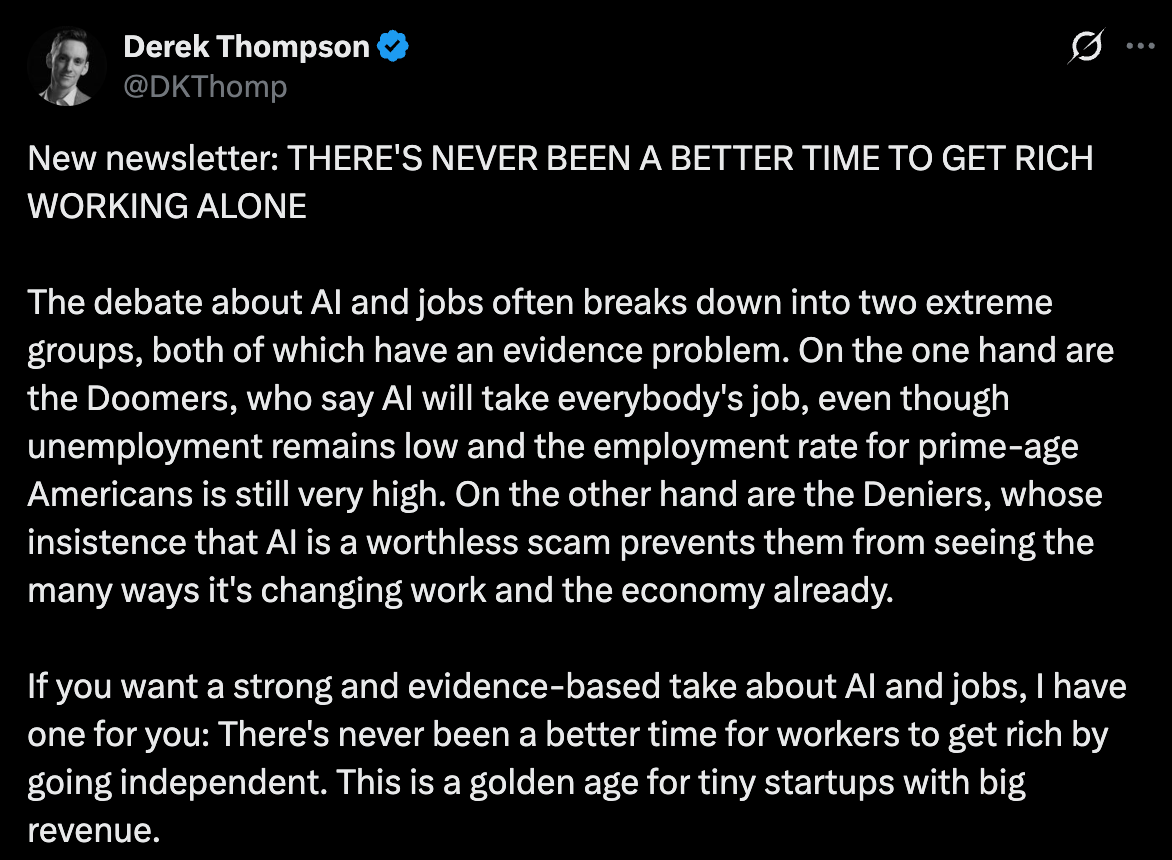
🌶️ Thompson nails the exit from the tired doomer-vs-denier shouting match: the real story is that one person with AI can now run what used to take a team. "A golden age for tiny startups with big revenue" isn't a prediction for us — it's our org chart. We build with 5 agents for every human, and 100% of our code is written by AI. The barrier to "dangerously profitable solopreneur" isn't the tools anymore. It's whether you'll pick them up.
Follow the Money: A Generational Transfer in Free Cash Flow
A striking BofA Research chart (via @pequityresearch) shows where the AI money is really landing. When hyperscalers build data centers, buy GPUs, and expand power and networking, their free cash flow gets hit first — but the money doesn't vanish, it flows upstream to chips, memory, equipment, and power. The projection: semiconductor free cash flow rocketing toward ~$450B by 2027, while the hyperscalers (Amazon, Google, Meta, Microsoft, Oracle) dive toward negative territory. It's a timing gap between the spenders and the receivers in the AI capex cycle.
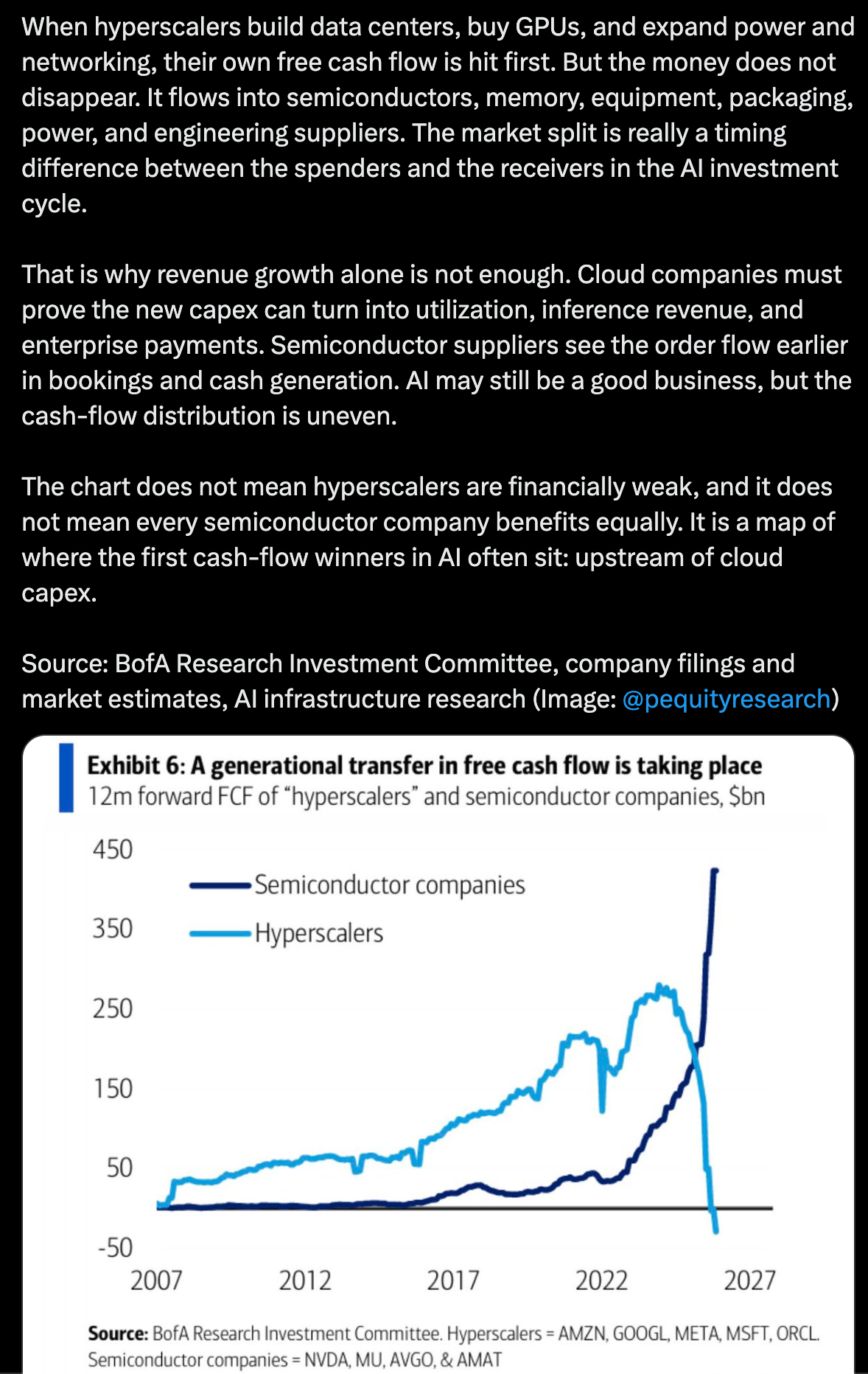
🌶️ Follow the cash, not the hype. The cloud giants are torching free cash flow to build the AI world; the picks-and-shovels crowd upstream collects first. For anyone actually building on AI, the lesson isn't "go buy chip stocks" — it's that all that capex eventually has to turn into real utilization and real revenue. That's the entire game: not spending on AI, but turning AI into money. It's why we're obsessed with agents that do real work for real dollars — no blockchain required.
For the Dinner Party: ESPN Built an AI That Reads Poker Faces
ESPN's World Series of Poker coverage this year quietly added a computer-vision model that flags when a player is likely bluffing — based purely on how they move their face. On-screen, it tracks blink rate, fidgeting, gaze, mouth, and posture in real time, feeding a live "Hand Strength" readout that ranges from Bluff to Monster. An AI lie-detector, broadcast over live poker to hundreds of thousands of viewers.
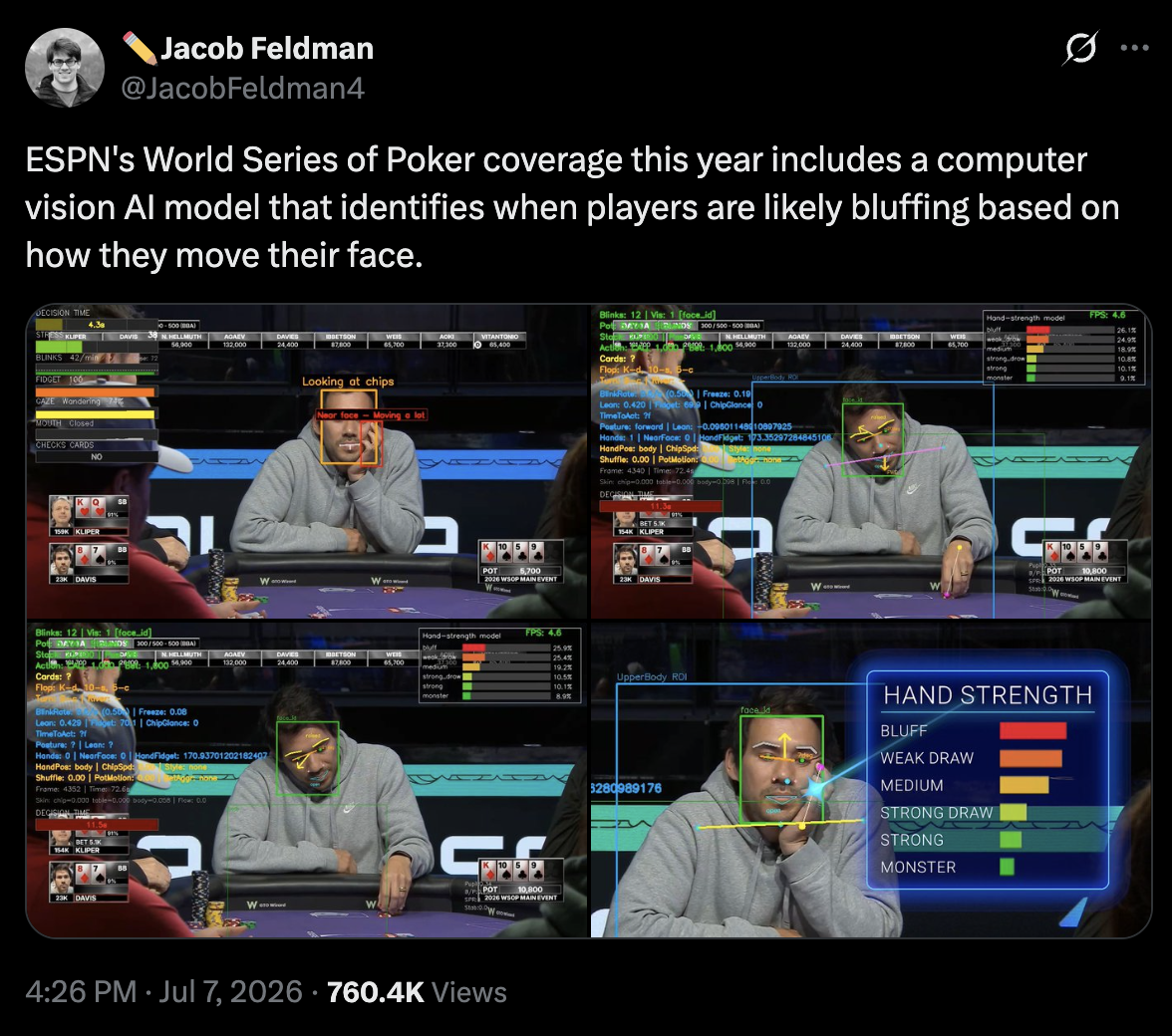
🌶️ An AI that reads your face in real time and broadcasts your bluff to the world — and it debuted on ESPN, not in a research lab. This is the quiet story of 2026: computer vision graduating from demo to primetime. Today it's poker tells. Tomorrow it's every sales call, support chat, and negotiation getting read by a model. Fun now, profound soon. (Also: pour one out for the poker face as a career skill.)
Chipp Updates
Chipp Chatter is now a live show. Every week we round up the AI news that matters — and the stuff that's just fun to know — so you're the sharpest person in the room. Get notified on YouTube →
Chipp Con: Fargo — July 30. A full afternoon of AI strategy and hands-on workshops, then the Night Bazaar. Get tickets →
Chipp helps you build AI agents that work. Start building at chipp.ai — and get notified for the next live Chipp Chatter.


